At my husband’s funeral, I received a text from an unknown number: “I’m alive. Don’t trust the children.” I thought it was a cruel joke.
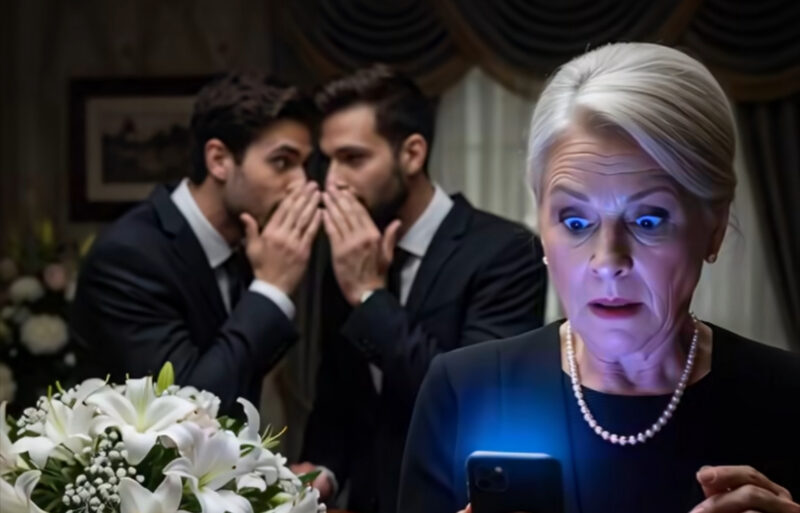
My husband Ernest’s funeral was the quietest day of my entire life. There, beside the freshly dug earth that was about to swallow forty-two years of my life, my phone vibrated. A message from an unknown number sent an icy chill through my grieving soul.
“I’m alive. That’s not me in the coffin.”
My world, already shattered, crumbled into dust. My hands trembled so violently I could barely type a reply. Who are you?
My husband Ernest’s funeral was the quietest day of my existence. There, beside the freshly dug earth that was about to swallow forty-two years of my life, my phone buzzed. A message from an unknown number sent a chill racing through my grieving soul:
“I’m alive. Don’t trust the children.”
The answer nearly knocked the breath out of me.
“I can’t say. They’re watching. Don’t trust our sons.”
My eyes drifted to Charles and Henry—my own boys—standing near the coffin with strange, placid expressions. Their tears looked rehearsed, their embraces as cold as the November air. Something was terribly wrong. At that moment, the world split in two: the life I thought I had, and the dreadful truth only beginning to unravel.
For forty-two years, Ernest had been my safe place. We’d met in the small town of Spring Creek, two poor kids with modest dreams. His hands were stained with grease, his smile shy, and I fell for him instantly. We built a life in a two-bedroom house with a leaky tin roof, but we were happy. We had something money could never buy: real love.
When our sons were born—Charles first, then Henry—my heart nearly burst. Ernest was a wonderful father, teaching them to fish, to fix things, telling them bedtime stories. We were a family, or so I believed.
But as the boys grew, distance crept in. Charles, restless and ambitious, rejected Ernest’s offer to help in his bike repair shop. “I don’t want to get my hands dirty like you, Dad,” he said, his words cutting Ernest like a knife. Both boys left for the city, made fortunes in real estate, and slowly, the sons we raised turned into wealthy strangers.
Their visits became rare. Their expensive cars and luxury suits clashed with our simple life. They looked at the home where they’d taken their first steps with a mix of pity and shame. Charles’s wife, Jasmine—a woman carved from the ice of city life—barely hid her disdain for our world. Family Sundays faded, replaced by their talk of investments and the not-so-subtle pressure to sell our home.
“Jasmine and I will need help with expenses when we have kids,” Charles said one uncomfortable dinner. “If you sell the house, that money could be an early inheritance.”
He was asking for our legacy while we were still alive. Ernest, calm but firm, replied, “Son, when your mother and I are gone, everything we have will be yours. But while we live, our choices are our own.”
That night, Ernest’s face carried a worry I had never seen. “Something isn’t right, Margot. It’s not just ambition. There’s something darker at play.” I had no idea how right he was.
The “accident” came on a Tuesday morning. The call was from Memorial Hospital. Your husband has been in a serious accident. You need to come immediately. My neighbor had to drive me; I was shaking too hard to hold the keys.
When I arrived, Charles and Henry were already there. I didn’t think to question how they knew before me. “Mom,” Charles said, hugging me with a strange, rehearsed force, “Dad’s in bad shape. One of the machines in the shop exploded.”
In the ICU, Ernest was barely recognizable—hooked to machines, face wrapped in bandages. I held his hand, and for the briefest moment, I felt the faintest squeeze. He was fighting. My warrior was still fighting for me.
The next three days were hell. Charles and Henry seemed more interested in speaking with doctors about policies than comforting their father. “Mom,” Charles said, “we’ve looked into Dad’s insurance. He has a life policy for $150,000.”
Why were they talking about money while Ernest was fighting for his life?
On the third day, the doctors told us his condition was critical. “It’s very unlikely he will regain consciousness,” they said. My world collapsed. But Charles saw only logistics. “Mom, Dad wouldn’t want to live like this. He always said he never wanted to be a burden.”
A burden? My husband, their father, a burden?
That night, alone in his room, I felt Ernest’s fingers move again—clutching mine, lips struggling to form words. I called the nurses, but when they arrived, he lay still. “Involuntary spasms,” they explained. But I knew. He had been trying to tell me something. Two days later, he was gone.
The funeral arrangements blurred past, handled with chilling efficiency by my sons. They chose the plainest coffin, the shortest service, as if they wanted the matter closed quickly.
And now, standing at his grave, I clutched the phone that carried an impossible message.
Don’t trust our sons.
That night, in our silent, hollow house, I went to Ernest’s old wooden desk. I found the insurance papers.
The main life policy had been updated only six months earlier—its coverage raised from $10,000 to $150,000. Why had Ernest done that? He’d never mentioned it.
Then I found something even more disturbing: an accidental workplace death policy I hadn’t known existed. $50,000 in the event of a fatal accident in the shop.
Two hundred thousand dollars in total. Enough to tempt someone without a conscience.
My phone buzzed again.
Check the bank account. See who moved the money.
The next morning, at the bank, the manager—who had known us for decades—pulled up the records. Over the last three months, thousands of dollars had been withdrawn from our savings.
“Your husband came in person,” she explained. “He said it was for repairs at the shop. I believe one of your sons came with him once or twice. Charles, I think.”
My stomach turned to ice.
If Ernest hadn’t touched that money himself… then who had been moving it in his name?